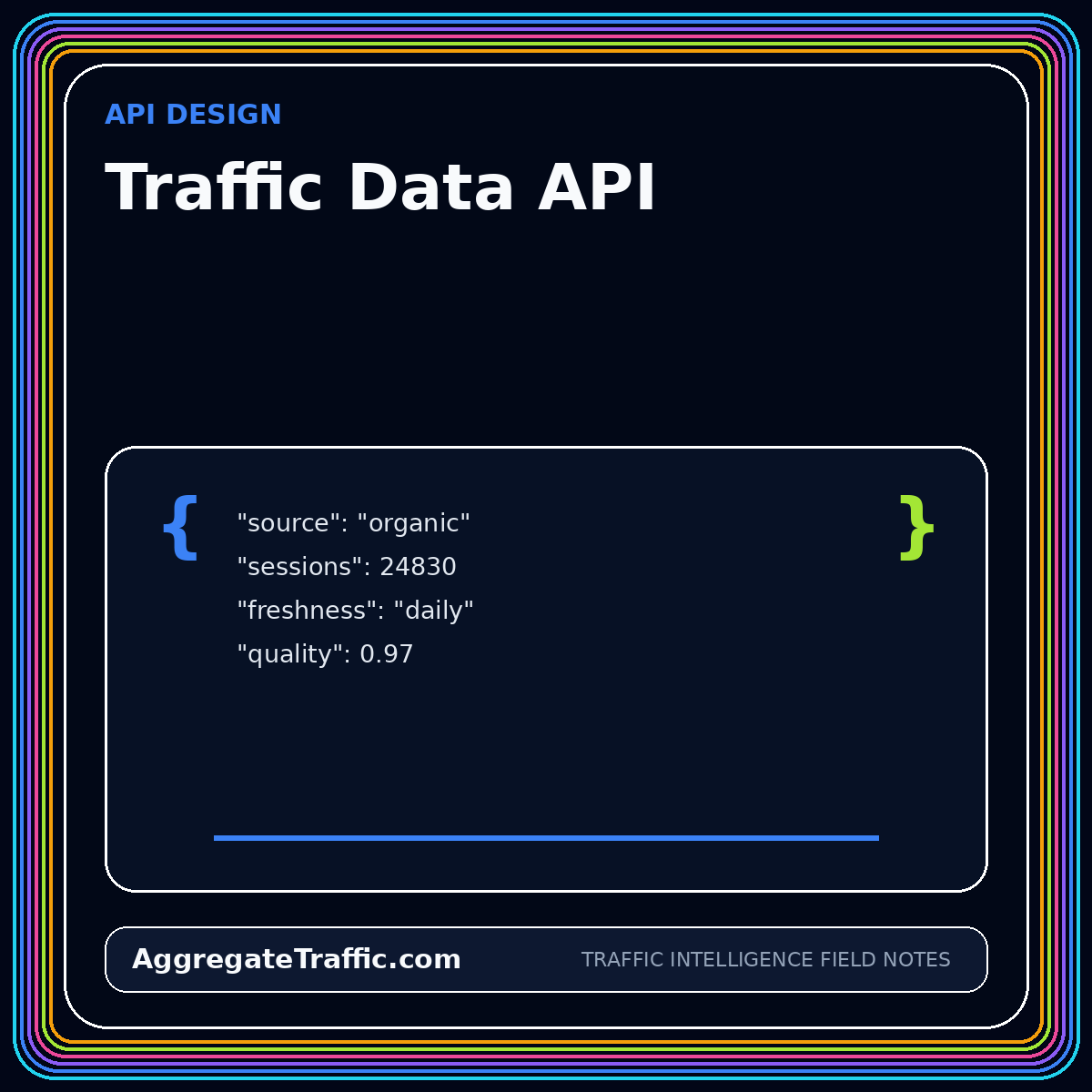
A traffic data API turns a measurement model into a reusable service. It lets dashboards, internal tools, scheduled reports, and analytical notebooks request the same governed metrics without duplicating connector logic. The hard part is not exposing JSON. The hard part is creating a contract that remains interpretable when source platforms change, late data arrives, campaign taxonomies evolve, and different consumers ask for different levels of detail.
A well-designed API makes context explicit. Every response should tell the consumer what was measured, at what grain, for which time window, with which definition version, and how current the data is. This guide focuses on the design choices that keep a traffic API stable and honest: resource boundaries, dimensions and metrics, filters, pagination, freshness, quality metadata, versioning, security, and operational governance.
Define resources around analytical concepts
Start with resources that match the way consumers reason about traffic. Common resources include channel performance, campaign performance, landing-page performance, search visibility, referral sources, funnel steps, and data quality. Avoid mirroring the tables of one source platform. A source-shaped API forces every consumer to understand vendor-specific schemas and makes it difficult to combine results across systems.
Operational implications
Each resource needs an explicit grain. A channel endpoint might return one row per date, property, channel, device, and country. A campaign endpoint might add platform account and campaign identifiers. Document the grain in the response schema and reject combinations that would produce ambiguous totals. When a consumer requests both campaign and page dimensions, the service should know whether that combination is supported and whether measures remain additive.
Use dimensions and metrics with precise contracts
Dimensions should have stable names, types, allowed values, and normalization rules. Metrics should define their numerator, denominator, counting method, deduplication behavior, and null semantics. A field called conversion_rate is incomplete unless the contract explains which conversion, which traffic population, and how sessions with missing identifiers are handled. Clear contracts prevent two teams from treating similarly named fields as equivalent when they are not.
Expose raw and canonical identifiers when both are useful. A campaign object can include a platform campaign ID, platform campaign name, normalized campaign key, and channel group. The raw values support reconciliation; the canonical values support comparison. Do not overload one field with changing meanings. Adding a new field is safer than silently repurposing an existing one, particularly when reports and automations depend on the response.
- Name fields for the business concept, not the dashboard label.
- Return ISO-formatted dates and identify the reporting timezone.
- Use explicit nulls for unavailable data; do not substitute zero unless zero is known.
- Include units for currency, duration, rate, and count measures.
Design query parameters for repeatable requests
A traffic API typically needs date range, dimensions, metrics, filters, sort order, pagination, and comparison options. Keep the request model declarative. The consumer should specify the result it needs rather than the sequence of source calls required to produce it. Validate parameter combinations before running expensive work, and return actionable error messages that identify unsupported dimensions, invalid filter operators, or date ranges outside available history.
Filters should use a small, consistent operator set such as equals, in, contains, starts_with, greater_than, and between. Define whether filters apply before or after aggregation. A country filter applied before aggregation is different from filtering aggregated rows after the fact. Stable request semantics make caching possible and let consumers reproduce a result later using the same normalized request.
Return freshness and reporting context with every result
Traffic data is often revised after its first appearance. Platforms may process late events, update attribution, apply privacy thresholds, or restate campaign costs. The API should expose a data-through timestamp, extraction timestamp, source status, and revision policy. A response for yesterday should not look equally final as a response for a month ago if the underlying systems continue to change recent periods.
Source documentation can help establish realistic expectations. Google Analytics reporting data expectations, for example, explains why API results and interface results may differ. An aggregation API should surface those kinds of constraints in its own metadata instead of requiring consumers to know every vendor nuance. Context is part of the data contract, not an optional footnote.
Make pagination, limits, and partial results predictable
Use cursor-based pagination when result sets can change between requests, and offset pagination only when ordering is stable enough for the use case. Return the applied sort, page size, next cursor, and an indication of whether the result is complete. If a source limits the number of rows available, do not present the response as an exhaustive list. A partial result should carry a partial flag and a reason.
Set sensible limits for dimensions, metrics, date range, and row count. Expensive high-cardinality requests can degrade the service for every consumer. Consider asynchronous exports for large extracts while keeping the interactive API focused on decision-oriented queries. Rate-limit by consumer and cost rather than only by request count, because one broad query can be far more expensive than many small cached queries.
Add quality metadata and reconciliation endpoints
Consumers need a way to distinguish a true business change from a pipeline issue. Include quality metadata such as expected source coverage, missing partitions, mapping exceptions, null rates for required keys, and reconciliation status. For critical resources, expose a dedicated quality endpoint that summarizes load status by source and date. This lets dashboards display a warning instead of silently showing an incomplete total.
Reconciliation endpoints can compare modeled totals with source totals at a supported grain. The goal is not to force perfect equality across unlike systems. It is to quantify expected differences and flag unexplained variance. Store the tolerance, source query, model query, and result so that a discrepancy can be investigated later. A reconciliation history is also useful for detecting gradual drift after a platform or taxonomy change.
- Coverage: all expected accounts, properties, currencies, and dates loaded.
- Freshness: latest complete reporting period and latest attempted extraction.
- Validity: schema and allowed-value checks passed.
- Reconciliation: modeled totals fall within a documented tolerance.
Version behavior, not just URLs
An API version should represent a behavioral contract. A new path such as /v2 is useful only if changes inside that version are controlled. Classify changes as additive, compatible, deprecating, or breaking. Adding an optional field is usually compatible. Changing the calculation of sessions, renaming a channel value, or altering null behavior can break analyses even when the JSON shape stays the same.
Publish a changelog with effective dates, migration guidance, and examples. Support overlapping versions long enough for consumers to test. For metric-definition changes, consider returning a definition_version field so reports can identify which logic produced a value. When history is restated, record the restatement window and reason. Reliable consumers need to know whether a changed number reflects the business or a changed model.
Secure the service according to data sensitivity
Use least-privilege access and separate aggregate reporting from sensitive event or identity data. Many consumers need channel, campaign, and page summaries but do not need user-level identifiers. Scope tokens to approved resources, properties, and date ranges where practical. Log requests, denied access, large exports, and administrative changes. Avoid putting secrets or personal identifiers in URLs because URLs are commonly logged by clients and infrastructure.
A mature traffic API also has operational owners, service-level objectives, incident procedures, and a retirement process. Monitor latency, error rate, cache effectiveness, source failures, and consumer usage. Review unused fields and endpoints before carrying them indefinitely. The API should evolve with the measurement program, but governance should make that evolution visible and manageable rather than surprising downstream teams.
Conclusion
The most valuable feature of a traffic data API is consistency. It gives multiple teams one place to obtain the same metric definitions, quality status, and reporting context. That consistency reduces dashboard drift and makes automated decisions easier to audit.
Build the contract from the consumer’s analytical question, define the grain and semantics, expose freshness and limitations, and version every meaningful behavior. The traffic data API design guide provides a compact implementation reference for these choices.