UTM parameters are simple text fields, but the reporting system built on them can become chaotic quickly. One team writes paid-social, another writes paid_social, and a third uses facebook as both a source and a medium. Campaign names acquire spaces, dates, initials, and inconsistent abbreviations. The links still work, but the resulting reports fragment into dozens of values that require manual cleanup.
Governance turns campaign tagging from an individual habit into a shared measurement process. The objective is not to create the longest possible naming convention. It is to define a small set of fields, controlled values, validation rules, and ownership practices that produce stable acquisition reporting across channels, agencies, regions, and time.
Assign one purpose to each parameter
Define the semantic role of every parameter before choosing values. Source should identify the publisher, partner, list, or platform that sent the visit. Medium should describe the broad delivery mechanism. Campaign should identify the coordinated initiative. Content can distinguish creative, placement, or message. Term can capture paid keyword information when manual tagging is appropriate. When fields are used interchangeably, no downstream rule can fully repair the ambiguity.
Operational implications
Write examples for each major channel and include examples that should be rejected. A policy becomes easier to follow when users can see that linkedin belongs in source, paid_social belongs in medium, and spring_product_launch belongs in campaign. Keep the taxonomy small enough that a campaign manager can apply it correctly without memorizing dozens of exceptions.
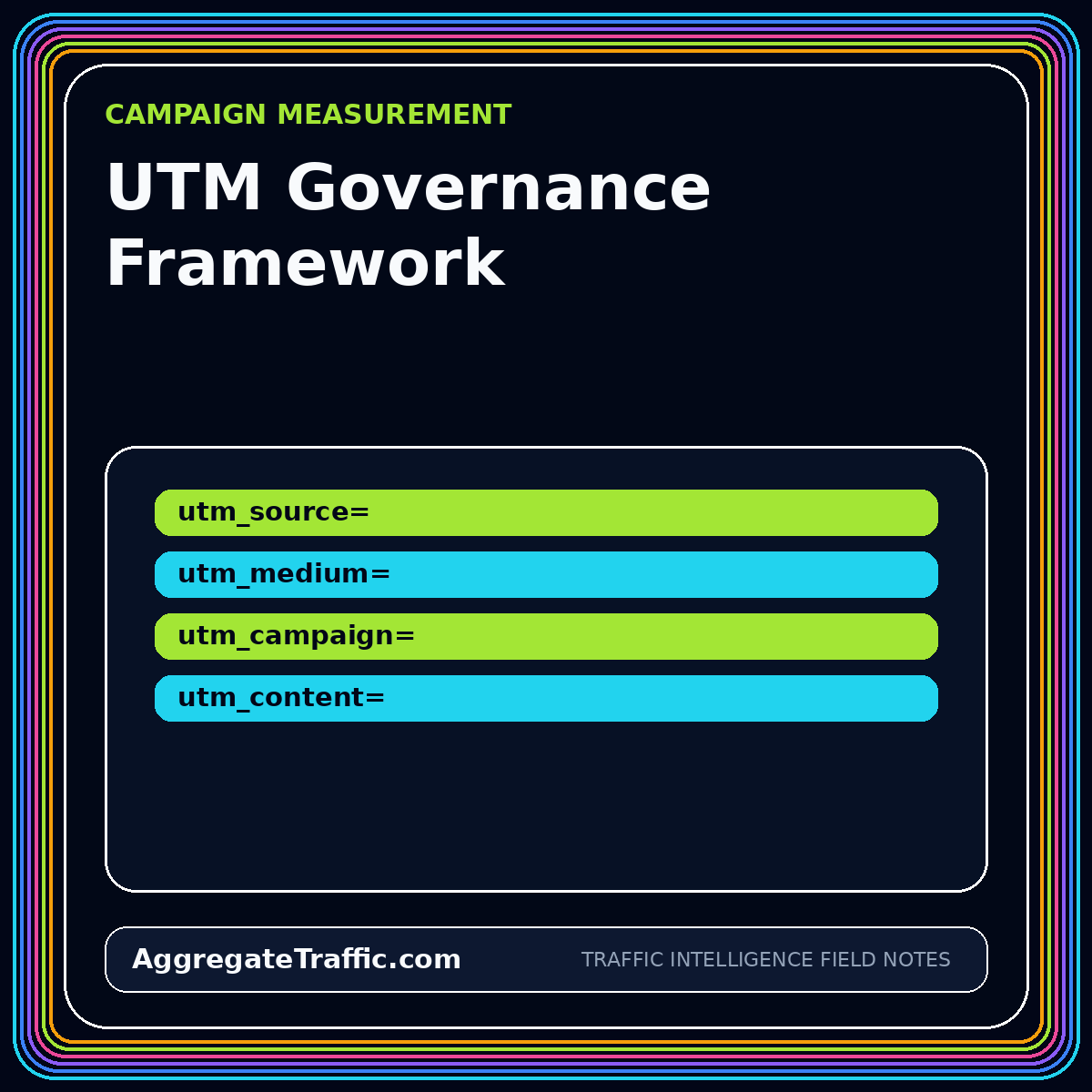
- utm_source: where the visit was referred from.
- utm_medium: how the message or link was delivered.
- utm_campaign: which coordinated initiative the link belongs to.
- utm_content: which creative, placement, or variant was used.
Use controlled vocabularies for stable dimensions
Choose controlled values for medium, region, product, audience, and other recurring elements. Lowercase values, one delimiter, and no spaces reduce accidental fragmentation. Avoid embedding labels that change frequently, such as an employee name or temporary organizational structure, unless that element is genuinely required for analysis. Stable dimensions should survive personnel and agency changes.
Source values require particular care because platforms and publishers may have common abbreviations, domains, or brand names. Create a reference table with the approved source, display label, channel mapping, owner, and effective dates. If a platform is renamed, decide whether historical values remain unchanged or are normalized through a reporting layer. Do not rewrite old links unless there is a clear operational reason.
Design campaign names for parsing and recognition
A campaign name should be recognizable to humans and structured enough for machines. Include only elements that support recurring analysis, such as initiative, product, market, objective, and launch period. Order the elements consistently. A name like productx_us_acquisition_2025q3 is more useful than summer_push_final_v2 because its components have defined meanings and can be validated.
Do not force every possible dimension into the campaign field. Creative, audience, and placement can use their own parameters or platform metadata. Extremely long campaign names increase mistakes and make reports harder to scan. The campaign identifier should function as a durable key, while display labels and descriptive metadata can live in a campaign registry.
Provide a governed link-building workflow
Users need an approved way to create links. A spreadsheet with data validation can work for a small team; a controlled internal tool or campaign-management integration can support larger organizations. The workflow should generate encoded URLs, validate required fields, prevent disallowed values, and save the resulting campaign record. Copying a prior link and editing it by hand should be the exception, not the standard process.
Google Analytics URL builder guidance explains how custom campaign parameters can be added to destination URLs so referred campaign traffic can be identified. Governance adds the organizational layer that a generic builder cannot provide: approved vocabulary, ownership, campaign registry, quality checks, and a process for exceptions.
Validate the destination as well as the parameters
A correctly tagged link can still fail if the landing page redirects improperly, strips parameters, returns an error, or loads a different locale. Automated checks should confirm the final destination, status code, redirect chain, parameter preservation, canonical host, and mobile behavior. For high-value campaigns, test the link in a clean browser session and verify that the expected acquisition values appear in the analytics system.
Shorteners and QR codes add another layer. Store the final governed URL before shortening it, and maintain a registry that connects the short link or QR asset to the campaign record. Avoid services that make destination ownership unclear or that could expire. A campaign link is part of the measurement supply chain and should be managed with the same care as creative and budget settings.
- The URL resolves to an approved HTTPS destination.
- Redirects preserve required parameters and do not create loops.
- The campaign record has an owner and launch date.
- The analytics test produces the expected source, medium, and campaign values.
Handle auto-tagging and manual tagging deliberately
Advertising integrations may provide auto-tagging that carries richer platform identifiers than manual parameters. Decide when auto-tagging is authoritative, when manual values are added for independent reporting, and how conflicts are resolved. The policy should be specific to each platform and documented with the analytics configuration. Adding partial manual parameters without understanding precedence can produce unexpected channel classification.
Preserve platform click identifiers and campaign identifiers in the raw data when permitted and needed, but do not rely on them as the only business key. A normalized campaign registry can connect platform metadata, UTM values, budget ownership, creative themes, and business objectives. That registry becomes the bridge between operational platforms and cross-channel reporting.
Monitor taxonomy drift and repair it transparently
Create a recurring report of new source, medium, and campaign values. Flag values that are not in the approved vocabulary, differ only by case or punctuation, or map to an unexpected channel. Contact the owner while the campaign is still active. Fast feedback teaches the process and prevents a small mistake from spreading across many assets.
Correct reporting through a governed mapping layer rather than silently altering raw data. Record the original value, corrected value, reason, owner, and effective date. Some errors can be normalized confidently; others should remain flagged because the intended meaning is unknown. The repair process should preserve evidence so that analysts can explain why a historical report changed.
Make governance part of campaign operations
Assign an owner for the taxonomy and an owner for each campaign record. Include tagging review in launch checklists, agency briefs, and creative handoffs. Provide short training focused on the decisions the data supports rather than only on parameter syntax. People are more likely to follow the system when they understand how inconsistent values affect attribution, optimization, and reporting credibility.
Review the taxonomy periodically and retire values that no longer serve analysis. Add new values through a controlled request rather than allowing every team to create its own category. Publish changes and maintain compatibility mappings. Governance should be firm enough to preserve consistency and light enough that campaign teams can move without building shadow processes.
Audit the taxonomy with a compact monthly scorecard
A monthly governance scorecard should show the share of campaign visits using approved values, the number of new unrecognized sources and media, the most common casing or delimiter errors, links that failed destination checks, and records without an accountable owner. Break the exceptions down by team or agency so coaching can be targeted. The scorecard is not intended to punish individual campaign managers; it is an early-warning system for a shared reporting asset.
Pair the scorecard with a short review of whether the taxonomy still serves current decisions. A vocabulary can be technically consistent and still become obsolete when products, markets, or channel strategies change. Approve necessary additions, merge redundant values through versioned mappings, and publish the release notes before the next campaign cycle.
Conclusion
Reliable campaign reporting depends on consistent semantics more than on complicated technology. A governed UTM program gives every parameter a purpose, every recurring value an approved form, and every campaign a traceable record.
Standardize the vocabulary, generate links through a controlled workflow, test the destination, monitor new values, and preserve raw data when applying corrections. Continue with the marketing analytics guide to connect campaign taxonomy with attribution and qualified outcomes.